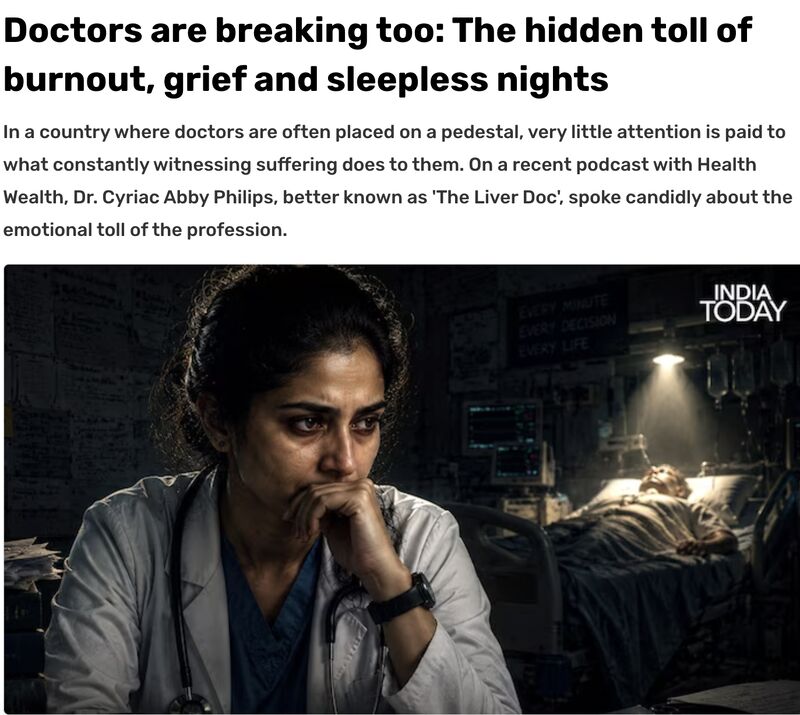
A doctor once said he might have ended his life if he had not written a book about his journey. I heard a hepatologist say this on a podcast recently, and I have not stopped thinking about it because of how easily we can imagine it being hidden behind a white coat. We talk about doctors as though they are built differently. We expect them to be selfless, disciplined and emotionally strong while trusting them with our lives, and rightly so. People forget that behind every white coat is a person who gets tired like everyone else, and healthcare systems leave very little room for the person behind the professional. This is the contradiction we need to confront.
We have become good at building technology to improve healthcare delivery. We have better diagnostics, connected devices, AI, automation and sophisticated hospital infrastructure. But are we building healthcare systems that are also sustainable for the people operating them?
When Exhaustion Becomes Normal
Consider some of the stories we hear in healthcare. A cardiologist I know once went nine months without taking a single day off, not even when his father was hospitalized. An emergency physician told me that the hardest part of the job was not dealing with emergencies. It was going home afterward and feeling nothing at all. Also, a resident doctor once messaged a friend at 2 AM saying she felt like she was disappearing but few hours later, she was back on rounds.
These are different people with different circumstances, but they have the same underlying problem. They kept going even when they were exhausted. Dedication, which is one of the most admirable qualities of healthcare professionals, is being misunderstood here.
When does commitment become a system that depends on people breaking themselves to keep functioning?
The Healthcare Workforce is Also an Infrastructure
Healthcare has spent years investing in infrastructure. We have invested in advanced imaging systems, robotic surgery, digital health platforms, AI-powered diagnostics, connected devices and automated workflows.
A hospital can have the most sophisticated technology in the world and still struggle if its doctors, nurses, technicians and administrative teams are overwhelmed. Technology improves healthcare only when people have the capacity to use it effectively. This is where the infrastructure crisis and the human crisis begin to overlap. Poor systems create unnecessary work and pressure which causes exhaustion affecting patient care. That is why burnout should not be treated purely as an individual problem.
A doctor may feel guilty about taking a day off because someone else will have to cover their patients. Senior professionals who themselves grew up in demanding environments may unintentionally pass the same expectations to the next generation. This is how culture reproduces itself. One generation survives an unhealthy system, then teaches the next generation how to survive it.
We need to break that cycle because there is a difference between teaching healthcare professionals to be resilient and teaching them that they must tolerate unhealthy conditions.
Technology Should Give Healthcare Workers Time Back
When I started Elixr Labs, the healthtech company, my focus was on solving operational problems in healthcare. The more time I have spent in this space, the more I have realised that operational efficiency is not separate from human well-being. It is directly connected to it. Every disconnected system creates another layer of work. One small inefficiency may not seem significant. But multiply it across hundreds of patients, dozens of healthcare professionals and thousands of interactions every day, and the human cost becomes huge.
This is where technology has an opportunity to do something much more meaningful than simply making hospitals digital. It can make healthcare more humane. It should give people fewer unnecessary things to worry about. Automation should not be about replacing the human element of healthcare. It should be about protecting it.
If a system can reduce repetitive administrative work, improve access to information, connect fragmented workflows and help healthcare teams spend less time on operational complexity, that time can go back to where it matters most, to the patients and to other close people. This is the kind of technology I believe healthcare needs. Technology that gives people their time back.
Building Healthcare That Takes Care of Its Workers
The future of healthcare will certainly involve more technology. AI will become more deeply integrated into clinical workflows. We need to design healthcare systems around the people who operate them, which means building workflows that respect their time, making mental health support accessible without stigma, and creating a culture where asking for help is not interpreted as failure. The goal should never be to build a system where healthcare professionals become better at surviving impossible workloads. It should focus on building a system where those workloads become less impossible.
I believe the next phase of healthcare technology should be judged based on, “Does it make healthcare better for the people delivering it as well as the people receiving it?” If the answer is yes, we are moving in the right direction. Because the doctor or the nurse is not the system. They are human beings working within the system. If we want healthcare to become more intelligent, efficient and sustainable, our first responsibility is to make the system intelligent enough to take care of them too.
What do you think keeps this cycle going?


The FIFA World Cup and the Business of Winning: Why Performance Builds Winners but Emotion Builds Fans
Employee Retention Beyond Loyalty: At What Point Does a Long Career Stop Being Growth and Start Becoming Inertia?

The Human Side of Healthcare Technology Transformation: Why Changing Workflows Is Harder Than Building Technology