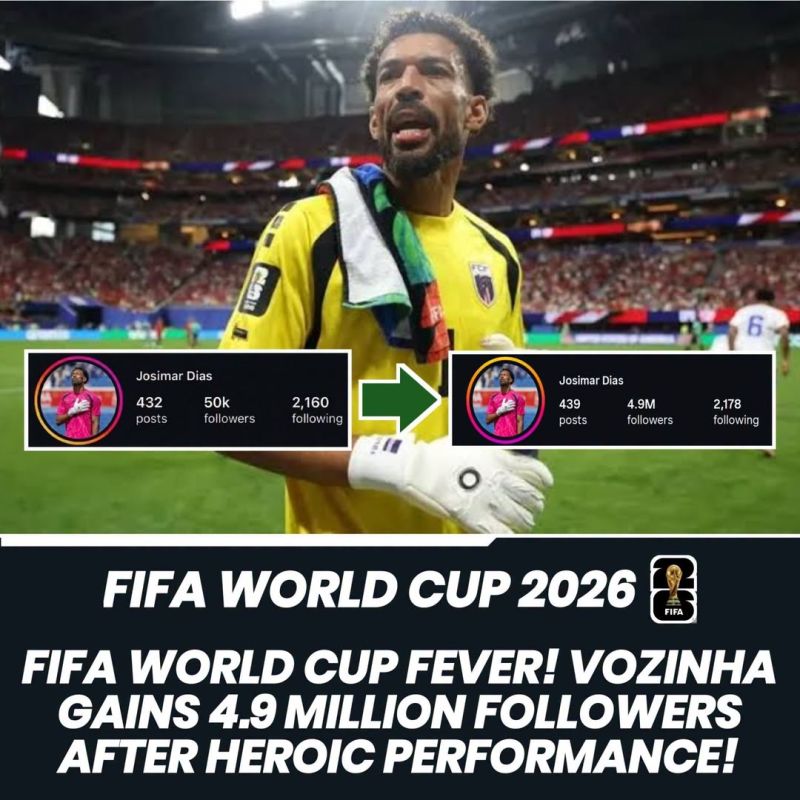
People did not buy tickets expecting to watch a 40-year-old goalkeeper. But then, the game began. The goalkeeper made save after save. Seven in total. He stood between his team and one of the strongest sides in world football and refused to be intimidated. By the final whistle, his performance had captured the attention of millions. That is the team Cape Verde, a nation of only 500,000 people, during their first ever game, had a draw with the legendary team Spain at this FIFA World Cup. Almost overnight, he became a story people wanted to talk about.
Sometimes, the world arrives to watch the famous names and leaves talking about someone they had never heard of. The World Cup has always been full of these contradictions. The best-known team does not always win. The most expensive squad does not always perform the best. A nation with millions of passionate supporters can be defeated by a team representing a country with a fraction of its population. And perhaps that is why the tournament is so compelling. It is where merit meets emotion. It is also a lesson that businesses, leaders and organisations would do well to understand. Because in business, just like football, being the best-run organisation and being the organisation people are most excited about are not always the same thing.
The Power of Preparation
Every World Cup introduces us to teams that were never expected to go far. They may not have the biggest budgets, the most globally recognised players or millions of people predicting their success. Somehow, they compete and they win. Teams such as Morocco and Switzerland have showed us what can happen when preparation meets discipline. They may enter tournaments with fewer expectations than the traditional favourites, but they do not enter without a plan. Their success is built on preparation. Defensive structures are carefully organised, transitions are practised and opponents are studied. Small mistakes are reduced wherever possible. They know they have to earn every result. This is where many businesses can learn an important lesson. Preparation matters more than perception. A company does not need to be the biggest organisation in its industry to outperform a larger competitor.
A small business with a clear strategy can move faster than a large corporation. A young team with strong systems can deliver better customer experiences than an established brand. A company that listens closely to its customers can identify opportunities that a market leader has overlooked. Reputation may get you noticed. But preparation is what helps you perform. The organisations that consistently succeed behind the scenes are building processes, developing teams, analysing results and preparing for challenges before those challenges arrive. They understand that they may not always have the advantage of popularity. So, they build the advantage of discipline.
Discipline Alone Does Not Fill Stadiums
Here is where the story becomes more interesting. If winning were based only on discipline and preparation, football would be easy to explain. The best-organised team would always attract the largest crowds. But it is still the face of a global superstar that appears on jerseys. It is the possibility of seeing a legendary player in their final World Cup that encourages people to travel across countries. It is the emotional connection people have built over years that brings millions of viewers to their screens. People do not connect only with performance. They connect with stories. This is just as true in business.
A perfectly efficient company can still struggle to build a loyal audience if nobody feels emotionally connected to what it represents. Customers do not always choose a brand simply because it has the best product specifications. They choose brands they remember, trust and make them feel understood.
Businesses mostly make one of two mistakes. The first mistake is focusing entirely on what happens behind the scenes. They invest in systems, processes, efficiency and product development. All of these things are important. But they forget to communicate why anyone should care. They may have an excellent product, but nobody knows the story behind it. The second mistake is the opposite. Some businesses focus heavily on visibility. They invest in campaigns, influencers and advertising. They know how to create excitement. But behind the marketing, the customer experience is weak. The strongest brands understand both sides.
Every Business Has Its Own World Cup Moment
The World Cup reminds us that expectations are only predictions. They are not outcomes. The team everyone expects to win can lose. The player nobody expected to notice can become a hero. The smallest nation can produce one of the tournament's biggest stories. And in business, the same principle applies. You do not need to be the loudest voice in the market. But you do need to be prepared. You need to understand what you do well. You need to keep improving. Because success happens when merit and emotion meet. Merit gives you the ability to perform. Emotion gives people a reason to believe. The World Cup brings these two forces together in the most dramatic way possible. Every match begins with rankings and predictions. But it ends with human emotion.
For the ones who are building their companies, build the systems, do the preparation and focus on delivering real value. But do not forget the human side of telling stories and creating connections.


The Digital Solution to Delays in Radiology Results: A Game Changer for Patients
Lessons of a Lifetime: What My Journey as a Founder Has Taught Me

How Telehealth Brings Healthcare Closer to Rural Areas in India