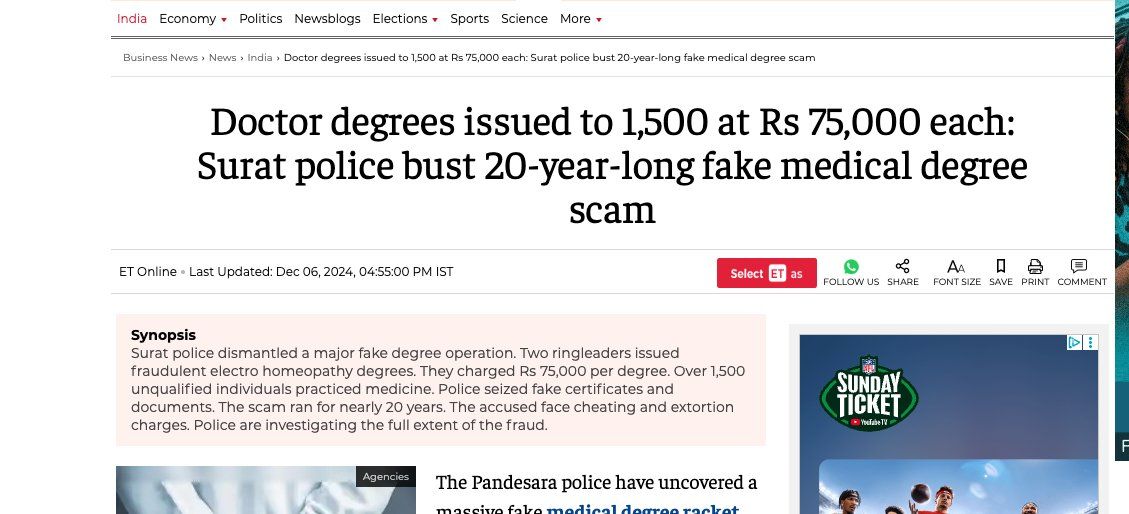
In 2025, a series of investigations by the Central Bureau of Investigation exposed what many suspected but few could prove: corruption in medical education. This multi-crore bribery network allegedly involved officials connected to the Union Health Ministry and the National Medical Commission (NMC).
This is the scam of faking an entire medical college. It is a public health crisis unfolding quietly. When a medical college is built on falsified inspections and bribery, the consequences that follow later are huge. Undertrained graduates enter the healthcare system, which leads to an increase in misdiagnoses.
Corruption in medical education is not just an ethical failure. It is an architectural failure. The system currently makes corruption easier than compliance. Until we redesign that architecture, reforms will remain superficial.
How the Medical College Approval Scam Works
To understand the scale of the problem, we must first understand the mechanics. These scams are not crude or improvised. They are sophisticated, repeatable playbooks that exploit loopholes in inspection and accreditation processes.
Dummy Faculty:
One of the most common tricks used by some medical colleges is the use of dummy faculty. These are doctors who are hired only for inspection days. They show up when inspection teams visit. Once the inspection is over, these doctors disappear. They never teach students or never guide interns. On paper, the college looks fully staffed. In reality, students are left without proper mentors or academic support, seriously affecting the quality of education.
Fabricated Patient Load:
Practical training is the heart of medical education. Students must learn by examining real patients, understanding real illnesses and assisting in real treatments. However, some institutions fake this experience. There are reports of hospitals hiring people for as little as ₹500 to lie in hospital beds during inspections. These patients have no real medical conditions. They are only there to create the illusion of a busy hospital with a high patient load. The damage caused by this is severe. Students may pass exams and earn degrees, but they graduate without enough hands-on experience. They know the theory but lack confidence, decision-making skills and clinical judgment.
Forged Biometric Attendance:
To prevent fake faculty, biometric attendance systems were introduced. These systems are meant to ensure that teachers are actually present and working regularly. Unfortunately, even these safeguards are sometimes manipulated. Attendance data can be falsely recorded. When inspections depend only on documents or short visits instead of continuous monitoring, corruption finds new ways to survive. The system looks modern and secure, but in practice, it fails to protect students or patients.
The Delayed Impact
Unlike financial fraud, which produces immediate measurable losses, educational corruption manifests years later. An undertrained doctor may pass licensing exams but struggle in real clinical settings. Misdiagnoses, delayed treatments and procedural errors accumulate quietly.
Families experience these failures as personal tragedies. A misdiagnosed illness is blamed on individual incompetence rather than institutional corruption.
This delayed accountability creates a dangerous feedback loop. Because the harm is diffuse and temporally distant, the incentive for reform weakens. Corrupt actors exploit this gap, knowing that consequences are unlikely to circle back to them.
How Do We Fix It?
The solution is not just stricter rules. It is through better system design. We must create systems where being honest is easier than cheating.
Independent and Random Audits
Inspections should not be predictable events that colleges prepare for like festivals. Inspection dates should be random and unannounced. Surprise audits prevent colleges from arranging fake faculty, staged patients or temporary infrastructure. When colleges know they can be inspected any day, honesty becomes the safer choice. Audit teams must:
- Come from independent agencies
- Be rotated frequently
- Have no local or regional connections to the institutions they inspect
Patient and Infrastructure Tracking
Instead of checking patient numbers only during inspections, they should monitor hospitals continuously. This can be done by linking college hospitals to:
- State health databases
- Insurance and treatment records
- Bed occupancy and admission systems
Criminal Liability
Fines alone do not stop corruption. For large institutions, they are just another business expense. When colleges fake faculty or patients, there must be criminal consequences, not just financial ones. This means:
- Legal cases against administrators
- Personal accountability for owners and decision-makers
- Clear consequences for the fraud
Making Information Public and Transparent
Citizens deserve access to information about the institutions training their doctors. This transparency also creates trust among people. Public dashboards should clearly show:
- Accreditation status
- Inspection reports
- Compliance history
- Any violations or penalties
From a founder’s perspective, I think systems that check, verify and monitor regularly are much stronger than the systems that depend only on trust.
What are your thoughts on this system?


The Intersection of Leadership and Sustainability in Healthcare

How Transparency Could Fix India’s Real Estate Problems
How LinkedIn Reconnected Me with a Friend After 27 Years