India does not necessarily need more healthcare in every place. It needs to make the healthcare it already has more reachable, connected and scalable. For a long time, I believed India’s healthcare challenge was fundamentally a numbers problem. We needed more doctors, more hospitals, more beds, more diagnostic centres and more specialists.
But as we expanded Elixr Labs, the healthtech company, across different parts of India, I began to see the problem differently. The challenge is that access to the resources is uneven.
A world-class specialist and advanced diagnostic technology may exist. But if the patient who needs them is hundreds of kilometres away, the existence of that capability does not automatically translate into access. Patients living in Tier-2 and Tier-3 cities, smaller towns and rural communities may have far fewer options when they need specialised medical attention. For someone living in a remote area, accessing a specialist can mean travelling several hours or even hundreds of kilometres. This distinction changes how we should think about the future of healthcare technology in India.
India’s Healthcare Challenge Goes Beyond Infrastructure
Another challenge lies inside healthcare facilities themselves. Many hospitals and clinics still depend on paper-based records, disconnected software systems and manual processes. Information may be stored in different systems without being easily accessible across departments or facilities. Healthcare workers also spend considerable time managing administrative tasks, documentation and repetitive workflows. These challenges do not simply create inconvenience. They can make it harder for healthcare professionals to spend their time where it matters most, with patients.
Digital transformation can help address these inefficiencies. But simply moving paper records into digital systems is not enough. The next step is making healthcare technology intelligent enough to support people working within the system. That is where AI has the potential to become particularly valuable.
How AI Can Extend Clinical Expertise
When people hear about AI in healthcare, one of the first questions is whether AI will replace doctors. For India's healthcare system, that may not be the most useful way to think about the technology. India does not need AI to replace its healthcare professionals. It needs technology that can extend their reach.
Think about a doctor who can currently see a limited number of patients in a day. With the right digital tools, clinical information can be organised faster, routine tasks can be automated, and decision-support systems can help the doctor work more efficiently. The goal is not to remove the doctor from the process. It is to help that doctor support more patients without compromising the quality of care.
The country needs solutions that can work across large populations, different levels of healthcare infrastructure, multiple languages and locations with varying levels of connectivity. AI could become one of the technologies that makes that scale possible.
How AI Connect Primary Care With Specialist Expertise
Consider the role of an ASHA worker. Accredited Social Health Activists are among the first points of contact between communities and the healthcare system, particularly in rural areas.
Now imagine an ASHA worker visiting a patient in a village where specialist medical support is not immediately available. Instead of relying entirely on limited resources or asking the patient to travel to a distant hospital, an AI-enabled healthcare platform could potentially help organise patient information, identify relevant risk factors and support the health worker with appropriate next steps. The system does not have to make the final medical decision. The human professional remains at the centre. But AI can provide information and decision support at the point where it is needed.
The same principle can apply to primary care physicians. A doctor working in a smaller town may encounter a complex case that requires specialist input. Traditionally, the patient may need to be referred to a larger hospital in another city. In some cases, that referral is necessary. But in others, better access to specialist guidance could help the primary care doctor determine whether a referral is actually required, what information should be collected, or how the patient should be managed while waiting for further evaluation. AI-enabled systems can potentially help connect these different levels of healthcare.
Why India's Healthcare AI Opportunity Is Different
India's healthcare AI journey is still developing. There are important challenges that need to be addressed, including data privacy, security, interoperability, clinical validation, regulatory requirements and responsible AI deployment.
In many developed healthcare markets, AI is being introduced into healthcare systems that already have extensive infrastructure, established digital records and relatively high access to specialists. India has a different problem to solve. It needs to improve healthcare access while simultaneously improving efficiency, connectivity and scalability.
A solution designed for a large metropolitan hospital may not work in a rural health centre. This makes adaptability essential. Healthcare AI in India needs to be designed around the realities of the people using it, which means technology must be practical, accessible and easy to integrate into existing workflows.
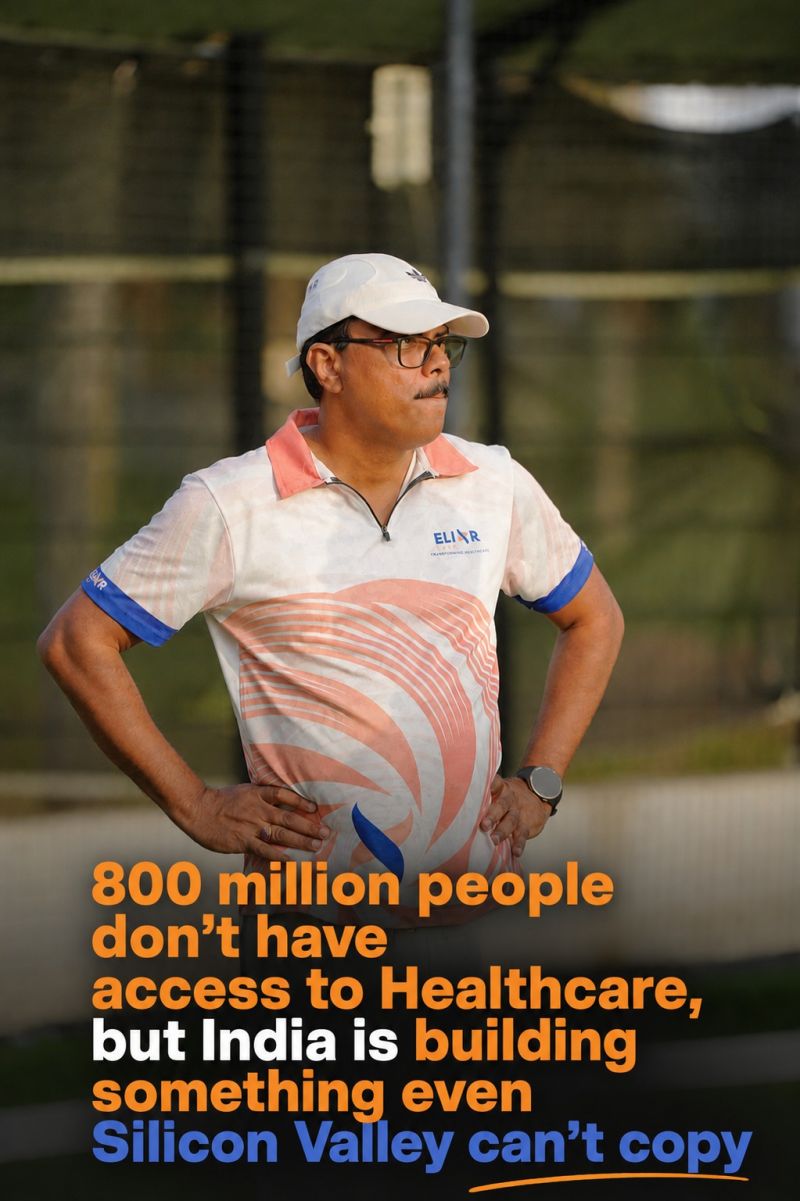
While Silicon Valley is building AI for hospitals that already work fine, India is building AI to reach the 800 million people who cannot access healthcare. India is not just catching up, it is about to lead healthcare AI globally.
What do you think is India's biggest healthcare challenge today?

Why Traditional Hierarchies Fail—and What Works Instead

The Future of Healing: How Nanotechnology is Changing Healthcare

What’s Next for Luxury Living? The Next Big Thing Revealed