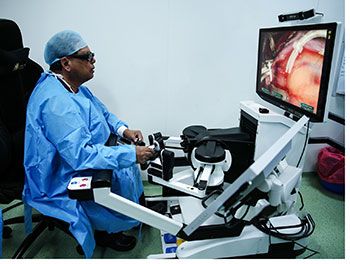
Most of us scroll past technology news every day. But once in a while, an innovation comes along that stops us and surprises us. In a remarkable step for both healthcare and technology, India has witnessed a genuine game changing moment. A doctor located over 280km away from the patient has operated that patient remotely using the SSI Mantra system. It has performed two cardiac surgeries in India.
Real patient, real recovery and real regulatory approval!
Why is SSI Mantra a major breakthrough?
Innovation often begins with excitement but the true impact comes only when it enters real-world practice. Most of the AI driven health tech tools used in India are caught up in an endless loop between conceptual proof and ambiguity in policy. Many health technology projects in India start with big ideas but get stuck between research and real-world use. They might present it before with several promises, but they could never scale it. They are able to innovate but they could not integrate. This is where SSI Mantra broke through. It broke the barrier of proof-of-concept. It also showed that the Indian regulatory framework is maturing and ready to accept advanced cases rather than just conceptual ones. It is like an AI model getting a driver’s license.
It opens up possibilities for better access to specialized surgical expertise, especially in rural areas and smaller towns, where surgeons do not necessarily have to be present right next to the patient physically.
I think it is a real milestone. They have built a system that allows it to operate.
Advantages of SSI Mantra
Every element of SSI Mantra points toward a new era where surgery is safer, recovery is quicker and healthcare is more accessible to anyone.
Minimal invasive procedures:
Traditionally, surgery meant significant physical trauma due to large incisions and patients often spent weeks on recovering, dealing with pain and risk of infection. SSI Mantra changes this as now the surgeries are performed through tiny openings which cause less tissue damage, reduced blood loss, less pain after surgery and also faster healing and recovery. So, it helps patients return to their normal lives far sooner, with better health and confidence.
Reduced risk of infections:
Surgical area infection is one of the biggest challenges in healthcare systems worldwide. Traditional open surgeries increase exposure to getting infections more likely. However, with fewer incisions and minimal tissue exposure, SSI Mantra significantly reduces the infection risks. Fewer cuts mean fewer chances of infection and this approach improves patient safety.
Shorter hospital stays:
Gone are the days when surgery meant days or weeks of hospitalization. When it comes to SSI Mantra, the minimally invasive procedures allow patients to go home much sooner and return to normal life quickly. Why this is also important because the families would face less emotional and financial strain, patient recovery may accelerate in the comfort of their home and also hospitals can manage more patients efficiently.
Remote access:
In a world where telemedicine is growing so fast, the concept of remote surgery has moved from imagination to reality. Now the surgeons can operate on patients while staying far away, but also in real time. Remote surgery is especially powerful during emergencies, natural disasters or when the specialized doctors are not available physically.
Predictive analysis:
Instead of relying solely on human observation, surgeons now have AI-powered guidance on ensuring enhanced patient safety and precision. The AI continuously studies vital signs and surgical data and alerts doctors about possible risks during surgeries.
The Real Breakthrough is not just the surgery
Yes, performing surgery remotely is impressive and sounds futuristic. But the real breakthrough lies in the system that allowed this to happen. Because for medical innovation to move forward, technology alone is not enough. You also need the government’s trust, clinical validation on real patients, ethical and safety standards, training for medical teams, secured communication technology and a hospital’s confidence to use it. Most countries seem to struggle to align all of these at the same time. India not only developed one but also deployed it responsibly.
A Turning Point of Trust in Health Tech
On the surface, it sounds like a cool technology story.
A surgeon in one city.
A patient in another.
And a robot bridging the distance between them.
But the real weight of this moment is not the robot arm. It is the system and the trust behind it. Technology succeeds not just because it works but because of the people who trust it enough to use it. Healthcare innovation is not like launching a new app or testing a new smartphone. When it comes to the field of medicine, you do not get to say that we will fix the bugs later. Here, human lives are involved and therefore trust is everything. The fact that this surgery happened within approved medical infrastructure shows the growing trust among doctors, regulators and the patients. And once trust enters the system, then the innovation accelerates. We are actually witnessing that moment through this new innovation.
For people like me watching health tech ethics and policy, this is truly heartening because we have often seen innovation being held back by policy ambiguity. And here, both the factors are very well aligning. It is a signal that India is building frontier tech and maturing into a market that can deploy it responsibly.What are your thoughts regarding this new health tech innovation?


Why Finding the Right Mentor Changes Everything?

The Silent Struggle of Leadership: Why Burnout Remains an Unspoken Truth

How the Post-Pandemic Era is Redefining the Global Real Estate Market