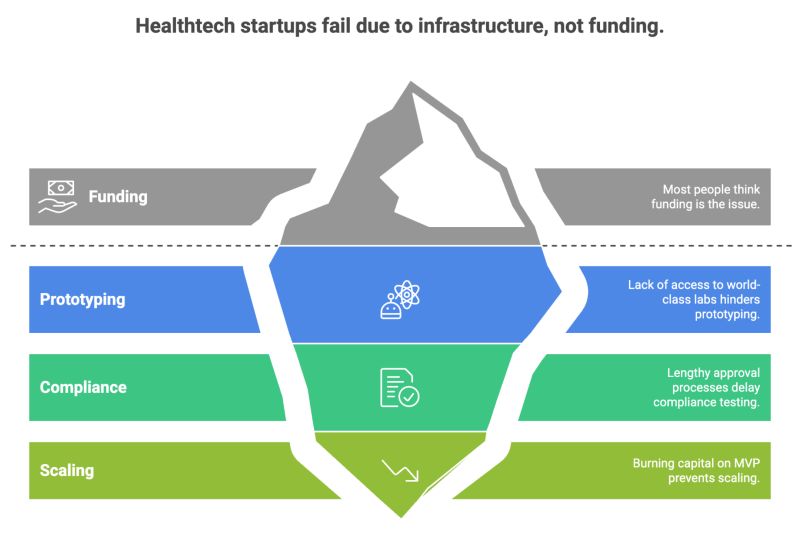
Healthtech startups often fail due to challenges in the infrastructure rather than just funding shortages. Andhra Pradesh MedTech Zone's i-Passport initiative addresses these by providing fast-track access to labs and regulatory support.
The Reasons Tech Startups Fail: Not Money but Infrastructure
In startups, a most decisive factor which determines whether their idea lives or not is thought to be funding. When it comes to healthtech, a different pattern emerges. Most startups do not fail because of funding, they fail because they lack access to the infrastructure to translate the vision they had into a working product. Infrastructure is an invisible foundation on which every innovation stands. When it is weak, even the best ideas collapse.
Whether you are building a medical device, a hardware product, a robotics system or anything that requires real-world validation beyond a laptop, you quickly realize that capital alone does not guarantee progress. What you truly need is access to labs, to testing facilities, to regulatory expertise, to compliance systems and a system that can help you move from prototype to market without burning millions.
Recently, I came across a model that addresses these root-level challenges directly: the i-Passport, an initiative launched by Andhra Pradesh MedTech Zone (AMTZ). It acts like a fast visa.
There are three major infrastructure-related points where tech and healthtech startups get stuck, lose time and eventually run out of cash:
1. Prototyping Without Access to Labs
It is easy to build an app in a bedroom. But it is nearly impossible to build a medical device, wearable or a diagnostic tool without any biosafety labs, CNC machining, advanced manufacturing tools and materials testing facilities. Access to advanced labs remains a top barrier. Most small startups cannot afford these and renting them privately is really expensive.
2. Compliance & Regulatory Delays
The wait times for approvals, certifications and compliance testing can stretch into months and sometimes years. For a startup with a runway of 12–18 months, this is not just a delay, and it is fatal. The approval processes involve:
- documentation cycles
- pre-certification testing
- regulatory consultations
- alignment with national or international standards
But the problem is not the need for regulation. It is the lack of structured guidance. This is where i-Passport becomes a game changer. Andhra Pradesh MedTech Zone (AMTZ) has launched the Innovation Passport (i-Passport), which is designed to provide entrepreneurs and innovators a key to transform their healthcare ideas into real-world solutions. It is made to empower the healthcare startups by offering a wide range of resources under a roof.
Key Features of i-Passport
This transformative system has plug-and-play facilities, advanced testing centres and fabrication labs to support product development, access to industry leaders, mentors and potential collaborators, and provides financial support through a network of funding partners.
1) Free or subsidized access to R&D labs & testing facilities:
This is generally offered to promote innovation, support economic growth and to bridge the gap between the academic research and collaboration with the industries.
2) Regulatory mentorship so you do not drown in paperwork:
This support turns months of delays into weeks and helps in fast approvals. It is like having a guide who knows every single shortcut.
3) Scaling without burning capital:
They connect you to incubators. There are 75+ incubations and now growing into 200+ ones. This helps the founders grow ten times faster without much spend.
And over 1000 startups have already plugged in and it is rare to see something that directly tackles the founder pain points that nobody really talks about. This is how you cut down months of delays and give real ideas a chance to hit the market before they run out of cash.
Why i-Passport Changes the Game
Most programs give money or just talk. But this i-Passport gives you real tools. i-Passport is a “fast-track visa” for innovators in healthtech giving them structured, prioritized and affordable access to everything they need to build, test, refine, certify, and scale their products.
The most dangerous thing in the startup world is not a shortage of money, it is the shortage of the right support at the right time. You can raise funds, but you cannot manufacture infrastructure overnight. Startups often fail because they are forced to spend their capital on things that should be public or shared utilities such as testing facilities, compliance processes and prototyping equipment.
And without infrastructure, founders lose not just money, but also their precious time. In the early stages of creation, time is a currency which is even more valuable than the capital. This is why initiatives like i-Passport matter. They give founders more time to experiment, learn, correct and innovate.
Also, when infrastructure fails healthtech startups, patients wait longer for solutions and healthcare costs remain high. Thus, every delayed innovation because of infrastructure is a delayed solution. In healthtech especially, these delays can have real human consequences.
So instead of asking founders how much funding is raised, we should be asking what infrastructure they have access to. And not every startup idea fails because it was a bad idea or because there was a lack of ambition. Many were simply because they were unsupported.
If there is one major issue tech startups face, it is that they are expected to innovate at global level without any global level infrastructure. So, what is a major issue that you have faced as a tech startup?


Climbing the Corporate Ladder: Why the Hardest Projects Build the Strongest Careers

How Microsoft’s Partnership Could Reshape India’s Employment System

How coto Is Building Safer Digital Spaces for Women’s Conversations