Organ transplantation has been one of modern medicine’s greatest achievements, still it has always carried a painful limitation that there are never enough donor organs available for the people who need them most.
Every year, thousands of patients with end-stage heart failure wait for a transplant that may never come. Even in the most advanced healthcare systems, organ transplantation depends heavily on timing, donor availability and luck. For years, medicine has focused on managing this shortage rather than eliminating it. But technologies like the BiVACOR artificial heart offer a completely different possibility that what if patients no longer had to wait.
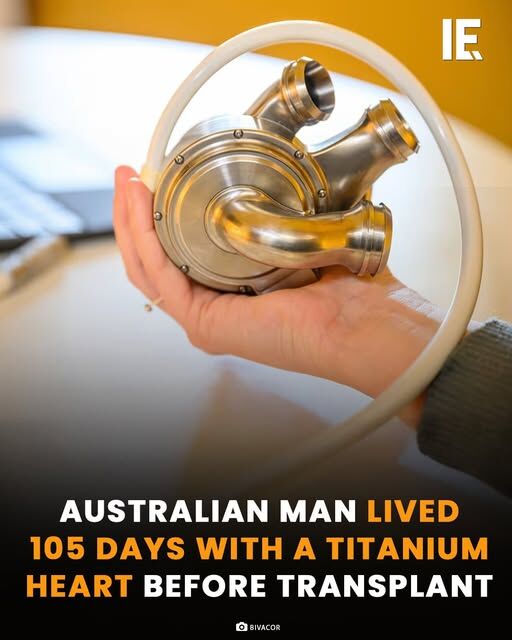
In 2025, a man walked out of a hospital without a human heart. For 105 days, an Australian patient stayed alive with a fully artificial titanium heart known as the BiVACOR Total Artificial Heart. This device had no valves, no chambers and no pulse. Instead, it used a magnetically levitated rotor to pump blood continuously through the body. Later, the patient received a donor heart transplant. But the most important part of this story was not the transplant itself. It was the fact that, for more than three months, an artificial organ fully sustained human life.
What Makes the BiVACOR Artificial Heart Different
Artificial hearts are not new. Researchers and engineers have spent many years trying to create devices capable of replacing the human heart. But earlier versions of artificial hearts faced many engineering and medical challenges.
- Limited durability
- High risk of blood clot formation
- Infection complications
- Bulky and complex structure
- Wear and tear caused by friction between moving components
The BiVACOR system approaches the problem differently. At the center of the device is a magnetically levitated rotor. This means the moving part of the heart floats using magnetic forces rather than making physical contact with surrounding surfaces. The design brings several advantages:
- Reduced Friction: By eliminating physical contact, the BiVACOR heart reduces wear and tear inside the device.
- Improved Durability: The system may operate longer with fewer failures. Long-term reliability still remains under study, but this has showed a major improvement compared to older designs.
- Simplified Internal Structure: The absence of valves and complex chambers has reduced the complexity of the structure.
- Continuous Blood Flow: It maintains continuous blood circulation allowing efficient blood movement through the body.
A Turning Point for Healthtech Innovation
This development of the artificial heart challenges one of the oldest assumptions in healthcare, that the human body’s biological limitations are unavoidable. When an organ failed completely, they only had limited options, hoping for a transplant.
Now, it is changing. If artificial organs become reliable, scalable and affordable, then the entire healthcare system could undergo a huge transformation. Organ waiting lists will shrink, emergency transplant shortages will decrease, patients gain better access to treatment and survival rates will improve. The overall quality of the life of the patients will be improved.
For healthtech founders, researchers, clinicians, and investors, this moment shows something far more important than a single successful procedure. Healthcare innovation which always focused on managing symptoms and supporting organ function temporarily has now entered a phase where replacement technologies are becoming realistic. Instead of waiting for failing organs to collapse, we are beginning to have alternatives. And these artificial hearts may only be the beginning. Healthcare is becoming deeply connected with artificial intelligence and advanced engineering. The line between medicine and technology is disappearing.
The Real Challenges Ahead
While this innovation is promising, it is important to remain realistic. Several critical challenges remain as well in terms of:
- Cost: Advanced artificial organs are extremely expensive to develop and manufacture. Initially, access will likely remain limited to highly specialized hospitals.
- Accessibility: Many healthcare systems may struggle to provide access equally especially in low resource regions.
- Long-Term Reliability: Researchers still need more long-term data regarding durability and safety.
- Ethical and Regulatory Questions: Governments and healthcare institutions will need updated frameworks for approval, monitoring and patient care.
The BiVACOR artificial heart is still early in its journey. Many questions remain unanswered. Widespread adoption may take years, perhaps decades. But medical revolutions would not happen overnight. History shows us that breakthrough technologies begin with a single successful case, like the first smartphone that seemed revolutionary, and now it is ordinary.
And in 2025, for 105 days, a man lived without a human heart. That single fact may end up changing the future of healthcare forever.
What happens when the waiting list becomes optional?


Healthcare Without Security? A Risk Too Big to Take

Why Feng Shui Could Be the Game-Changer in Real Estate?

Mentoring Across Generations: How the Leadership Game is Changing