Every year, millions of people around the world lose their lives to kidney failure, a condition that silently creeps in often going unnoticed until it is too late. In India alone, kidney diseases have become a major health concern. Two out of every three patients with end-stage kidney disease never receive proper treatment and many die while waiting for proper care, that is either too expensive, too far or even unavailable. Behind these numbers lie the stories of struggle of many families spending their life savings and patients traveling hours for multiple times. And worryingly, this number continues to rise every year.
The reasons are painfully simple: dialysis, the life-sustaining process that filters blood when kidneys cannot, is expensive, difficult to access and demands continuous medical supervision. Even with many advancements in global healthcare, dialysis in India has always faced three persistent barriers:
1. High Cost
Dialysis is not a one-time treatment. Most patients need two to three sessions every week, each lasting around four hours. And over time, the expense becomes too overwhelming. Even if they have partial government support, the recurring costs of treatment, medicines, transportation and hospital visits push countless families into financial distress. Families often sell their assets or take loans to continue their treatment and many discontinue treatment midway, not because they have recovered but because they have run out of resources.
2. Limited Accessibility
While major urban hospitals may offer dialysis facilities, rural and semi-urban regions lack those facilities. For those people, reaching a dialysis centre means traveling long distances often multiple times a week. This not only strains families at a financial level but also adds emotional and physical exhaustion.
3. Dependence of Clinical Supervision
Dialysis requires close supervision by trained technicians and nephrologists. Without enough trained professionals, expanding dialysis access becomes nearly impossible. Thus, there is a limitation to scalability.
The result of these barriers? Thousands of people silently give up treatment.
Many organizations tried to build low-cost dialysis units, but the challenge was not just affordability, there was a challenge of sustainability and safety. This is where Renalyx found its opportunity to make a difference.
The Innovation of Renalyx Hemodialysis
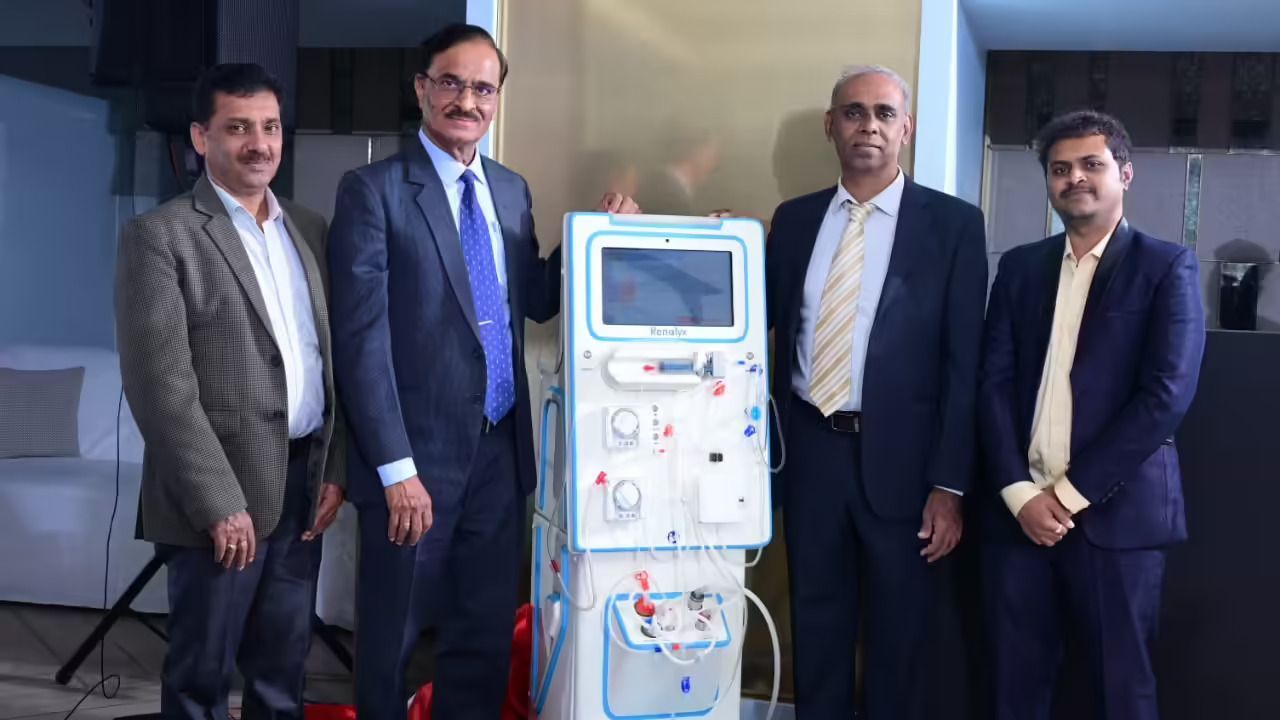
Bengaluru-based Renalyx decided to tackle this challenge head-on by addressing what everyone else overlooked. Renalyx was founded with a single powerful vision: to make dialysis accessible, affordable and intelligent without compromising on quality or safety. They developed India’s first indigenous hemodialysis machine, with AI and real-time remote monitoring capabilities. During a dialysis session, numerous parameters must stay within safe limits like blood flow rate, pressure and more. The Renalyx machine continuously captures and analyses this data in real time, ensuring every treatment stays within the prescribed safety window.
If a patient’s blood pressure drops or any fluid imbalance occurs, the machine sends immediate alerts to technicians and doctors. This predictive capability helps to prevent complications before they turn dangerous.
Predictive, Preventive and Proactive Care
Traditional dialysis machines react to problems while Renalyx’s AI-powered system predicts them.
- AI driven treatment insights: Personalized care recommendations based on data analytics and patient-specific trends.
- Remote Monitoring Capability: Doctors can oversee multiple patients from a centralized location which is very ideal for scaling dialysis in semi-urban and rural centres.
- Continuous data tracking and predictive monitoring: Each session’s data is stored securely, supporting long-term care and for research.
- Less operational costs: Because the Renalyx dialysis machine is designed and manufactured in India, it eliminates the high import and maintenance costs of foreign machines. This makes each dialysis session more affordable for both hospitals and patients.
This is accessibility redefined!
More important is that this new innovation is made in India and ready for the whole world. It has successfully combined technical excellence with social impact. It is not only life changing for patients but also for the health tech systems. It is advantageous for patients as it has lower treatment expense, reduced time travel, stress and also better-quality care. And in the case of healthcare systems, it is a foundational step for the future innovations in the health tech field.
Honestly, this is the kind of innovation that is moving thoughtfully one sector at a time and is saving lives. And in a world obsessed with flashy AI demos, this is the kind of quiet revolution we need to talk about more. Innovations were never meant for profit but they are to be used for people efficiently. People come first always.
Have you come across any India-born innovation that is quietly changing lives?Share it because stories like these deserve to be told, celebrated and scaled.

Fridge-Free Vaccines: Solving the Cold Chain Challenge in Healthcare
Why Health tech Innovation Works Differently in India and in Overseas
Cloud in Healthcare: Why Architecture Matters as Much as Adoption