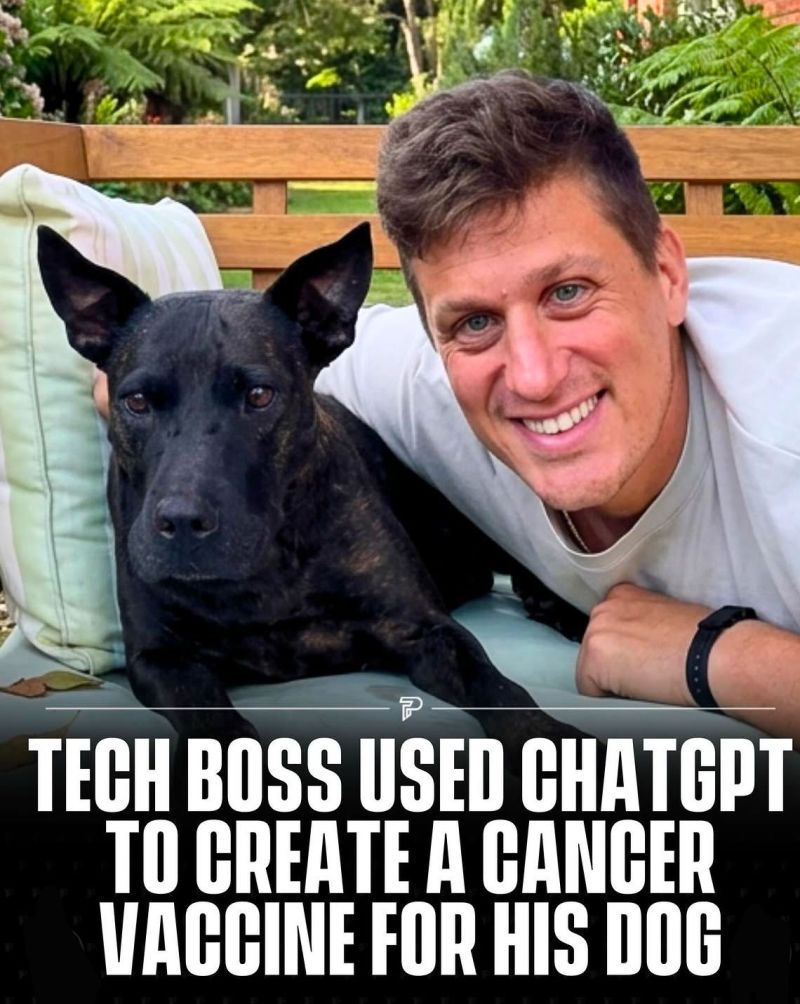
A few years ago, the idea of using artificial intelligence to help design a personalized cancer treatment for a dog would have sounded impossible to most people. Today, stories like this are beginning to happen in real life.
A Sydney-based tech entrepreneur, Paul Conyngham, shared a remarkable journey involving his dog Rosie, who was diagnosed with aggressive cancer. After several treatments stopped working, he decided not to give up and he took the help of AI to save his dog. The tumor DNA was sequenced, and AI tools were used to identify mutations. Researchers then helped him to develop a personalized mRNA vaccine designed for Rosie’s condition. To train the immune system to recognize cancer and fight back was the main idea behind it. Early reports showed encouraging signs. One of Rosie’s tumors shrank and her overall health improved.
Beyond the emotional impact of a person trying everything possible to save a beloved pet, this story points toward something larger and deeper. It highlights how artificial intelligence is beginning to reshape healthcare and personalized medicine in ways that were once difficult to imagine.
The Emotional Side of Innovation
What makes this story resonate so strongly is that it is not only about innovation. It is about commitment.
Anyone who has loved a pet understands the emotional connection people share with animals. Pets are companions, family members, emotional support systems and often silent witnesses to some of the most important moments in our lives. When serious illness enters, people naturally search for every possible option and that emotional determination is what makes this story feel deeply human.
When Rosie’s treatments stopped working, the easy path would have been to accept the limitations of the available options. Instead of that, Paul went on to see whether modern technology could help him create entirely new possibilities.
Healthcare is Becoming Personal
The Rosie case shows the intersection of three major shifts happening in healthcare:
- Artificial intelligence becoming more capable in medical research
- Genomics becoming faster and more accessible
- Personalized medicine
Together, these fields are bringing in changes in research.
Traditionally, medicine has been a generalized treatment path. Patients with the same diagnosis typically receive similar therapies. While this approach has saved millions of lives, diseases like cancer are difficult to be cured by this approach as it is rarely identical from one individual to another. Cancer mutates differently in different bodies. This is one reason cancer treatment remains so complex.
Personalized medicine attempts to address this challenge by turning treatment specifically in support to the individual patient. That is where genomics and AI become incredibly powerful together. In Rosie’s case, the tumor DNA was sequenced to identify the specific mutations creating the cancer. Once researchers understood the pattern, they began exploring therapies designed to target those exact abnormalities. Sequencing DNA creates huge amounts of biological data and that is where artificial intelligence enters the picture.
The Rosie case highlights this possibility of combining AI with personalized immunotherapy. This approach could become increasingly important in treating complex diseases like cancer. Importantly, AI is not replacing medical professionals. Instead, it is becoming a tool that enhances human expertise.
The Growing Role of AI in Healthcare
Many people imagine AI in healthcare to be just the robotic surgeons and machines. But some of the most transformative innovations that happened are less visible. It can be identifying patterns across huge datasets and patterns that would be extremely difficult or time-consuming for humans to analyse alone.
AI tools can also help researchers identify relevant mutations, compare biological patterns, predict therapeutic responses, and help in lessening the time taken for parts of the research process that previously took much longer.
It is also important to note that AI is not replacing doctors or scientists. Instead, it is becoming a tool that enhances human expertise. The most promising future for AI in healthcare is collaborative where human judgment, clinical experience and technology work together.
The Rosie case reflects this balance clearly. AI alone did not cure cancer. Human researchers, medical experts, genomic science, all played essential roles while AI helped in discovery and interpretation.
The story of Rosie and her AI-assisted personalized cancer treatment is emotional, inspiring, and scientifically important. It shows us that the combination of AI, genomics and personalized medicine has the potential to redefine how we treat disease not only for humans, but for animals as well. What once sounded impossible is slowly becoming real.
We are still in the early stages of this transformation. But stories like this offer a powerful reminder that technology becomes most meaningful when it helps life, extend hope, and create possibilities that previously did not exist.
What are your thoughts on this case?


Riding the Waves: Finding Depth and Purpose in Healthtech

Awareness Is the First Seatbelt for Child Car Safety and Here’s Why It Matters

How Renalyx Is Transforming Dialysis in India with AI and Indigenous Innovation