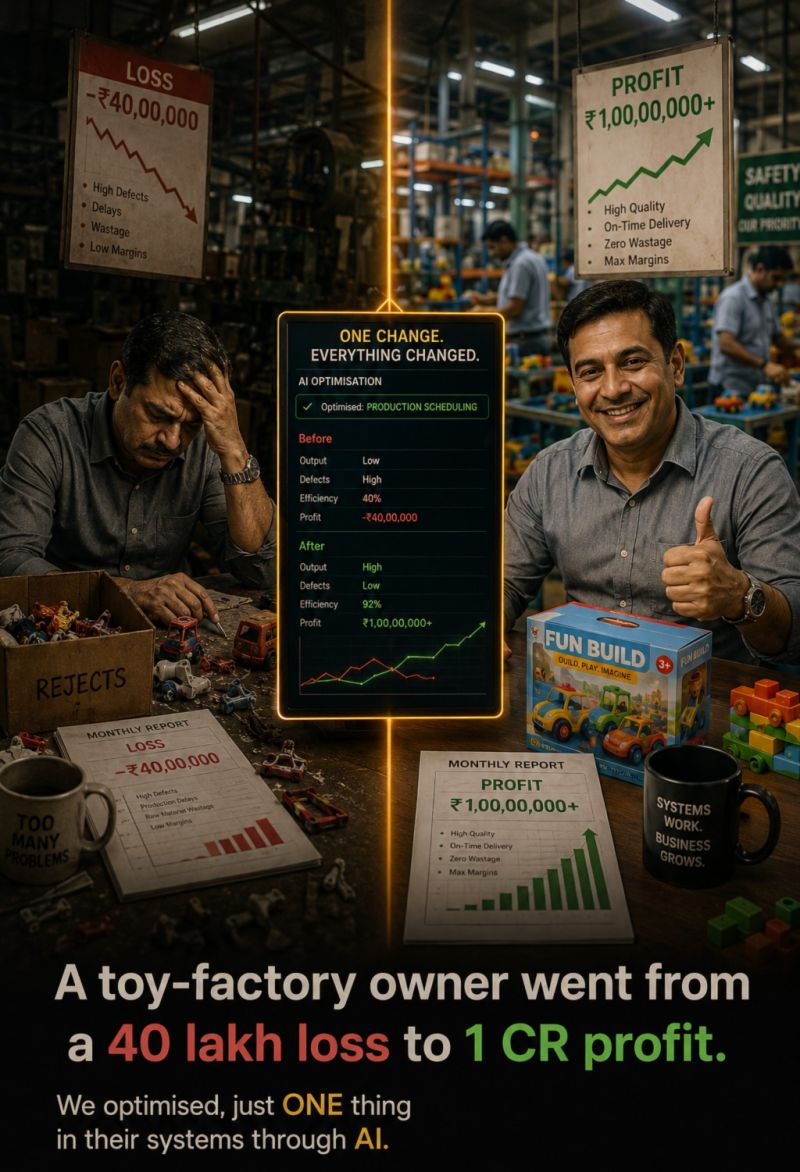
Most manufacturers are sitting on goldmines of untouched data. They are just not reading it yet. A few months ago, we worked with a toy-factory owner who was losing nearly ₹40 lakhs a month. The problem was not a lack of machines, technicians or data. The factory already had sensors, connected machines and years of operational information. The problem was that nobody was turning that information into decisions.
Unplanned downtime was quietly consumed into production. Every unexpected breakdown created another ripple through production, delivery schedules and profitability. This is not an unusual problem. It is one of the biggest opportunities sitting inside modern manufacturing today because the next competitive advantage for many factories may come from understanding the machines they already have.
Looking at the Problem in The Right Way
We did not ask the factory to replace its existing infrastructure. We started by understanding the operation. We mapped the factory floor, studied machine behaviour, examined operating information and started looking for patterns because machines do not go from perfectly healthy to completely broken without giving any signals. When you analyse thousands of data points over time, they can tell a very different story. That is where predictive AI becomes powerful. It helps to reveal what the human eye may not consistently see.
We did not give the factory new data, we gave its existing Data Intelligence. When people hear "AI in manufacturing," they imagine a massive technology transformation. But AI does not always require you to start from scratch. Sometimes, the opportunity is already sitting inside the systems you have. For this factory, we built a predictive intelligence layer on top of the existing sensors and operational data. The system could analyse historical and real-time machine information, identify patterns associated with potential failures and provide earlier indications that something might need attention. It changed the maintenance conversation from reactive maintenance to predictive maintenance.
Traditional maintenance follows one of two approaches. Run the machine until it breaks or maintain it according to a fixed schedule. Both approaches have limitations. If you wait for failure, you are accepting downtime as part of the process. If you maintain everything on a fixed schedule, you may end up servicing machines that do not need attention while missing problems that develop between scheduled maintenance cycles. Predictive maintenance introduces a third approach, letting the machine's behaviour guide the decision. It identifies necessary signals early enough for humans to act.
What Happened in 90 Days?
Within 90 days of implementing the predictive layer, the factory saw huge improvements.
- Downtime dropped by 60%.
- Maintenance costs fell by 35%.
But the most interesting change was not a number on a dashboard. It was what happened to the people running the factory. Floor supervisors were no longer spending most of their time responding to unexpected failures. They could plan, prioritise, allocate maintenance resources more intelligently, and focus on production instead of constantly firefighting. The business moved from dealing with losses of around ₹40 lakhs a month to moving towards ₹1 crore in profit. That is the part of AI adoption that I think businesses misunderstand. AI is not valuable simply because it is AI. It is valuable when it changes a business outcome.
A senior technician who had spent 22 years working on that factory floor looked at the system and said something that stayed with us: "This AI system is showing me things I always felt but could not see.” That, to me, captures the real future of industrial AI. It is not human expertise versus artificial intelligence. It is human expertise with artificial intelligence.
The Real Manufacturing AI Opportunity
For a manufacturing business, downtime is the few minutes when a machine stops. One machine failure can create a chain reaction. Production stops and orders get delayed. When these interruptions happen repeatedly, the financial impact can become large. Maintenance becomes reactive, teams spend more time firefighting, and valuable production capacity is lost.
Manufacturing has spent decades automating physical processes. The next transformation is about making those processes intelligent. I believe the real opportunity with AI is not in replacing the factory you already have. It is in unlocking the intelligence hidden inside it.
A skilled maintenance engineer may know that a machine is behaving differently from normal. AI can help identify that change earlier, compare it against years of historical data, and provide the evidence needed to act before a minor anomaly becomes a major breakdown. The same principle applies across the factory. AI can turn operational data into insights that help teams improve uptime, quality, efficiency and resource utilization.
Are you ready to start reading it?


What Leadership Qualities Are Crucial in the Healthcare and Hospitality Industries?
You Won't Believe This One Trait Successful Leaders Have in Common!
Is Your Healthcare Team Making a Deadly Mistake? Unmasking the Real Culprit!